

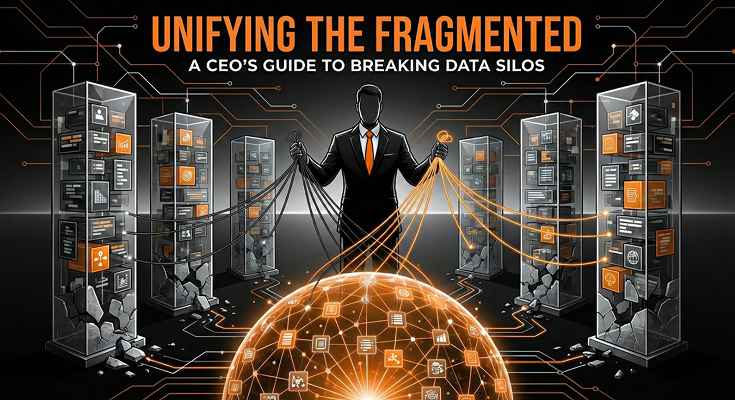
In today’s competitive business landscape, growth is no longer driven solely by expansion, marketing, or product innovation. Increasingly, the real multiplier of sustainable growth lies in something far more foundational:
How well your organization uses its data.
Yet for many enterprises—especially those operating across complex ecosystems like Retail, Logistics, and Finance—data remains fragmented, inconsistent, and trapped inside departmental walls.
This fragmentation creates what leaders know all too well:
The challenge is clear: data silos are not just an IT issue. They are a CEO issue.
This guide explores how executives can break down silos, unify departments, and build a Single Source of Truth that transforms data into a true growth engine.
Most organizations don’t intentionally build silos. They emerge naturally as companies scale.
Retail invests in customer analytics.
Logistics builds systems for supply chain optimization.
Finance creates its own reporting and forecasting models.
Each department becomes efficient—individually.
But the organization becomes fragmented collectively.
The cost is significant:
What results is a business running on multiple versions of reality.

High-performing companies share one key trait:
They operate as one organism, not three separate departments.
Cross-departmental unity means:
When data is unified, collaboration becomes proactive instead of reactive.
This isn’t about adding more meetings or reports.
It’s about ensuring everyone works from the same foundation.
A Single Source of Truth (SSOT) is more than a centralized database.
It is a strategic infrastructure that ensures:
With SSOT, organizations unlock:
Executives stop debating which numbers are correct and start acting.
Retail can deliver what it promises because Logistics is aligned.
Finance models become predictive, not retrospective.
Expansion becomes easier when systems and teams share one truth.

Eliminating silos requires leadership, not just technology. Here is a strategic roadmap CEOs can follow:
The goal is not “better data.”
The goal is:
Start with outcomes, then build data alignment around them.
Retail, Logistics, and Finance often measure success differently.
To unify, leadership must define shared KPIs such as:
Shared metrics drive shared accountability.
Many companies attempt to solve silos with quick integrations.
But scalability requires architecture designed for growth:
Infrastructure must evolve from departmental tools to enterprise intelligence.

Technology alone cannot unify organizations.
Leaders must encourage:
When teams trust the data, they trust each other.
Breaking silos is not a project to delegate and forget.
It is a strategic transformation requiring CEO sponsorship because:
The CEO must champion the shift from fragmented departments to one connected enterprise.
In the next era of business, the winners will not be those with the most data.
They will be those who can unify it.
Retail, Logistics, and Finance are not separate engines—they are one growth system.
By eliminating silos, building cross-departmental unity, and investing in a Single Source of Truth, CEOs unlock something powerful:
An organization that moves faster, scales smarter, and grows stronger—together.
If your organization is ready to unify operations, finance, and customer insight into one scalable foundation—