

Manufacturing performance is traditionally improved through familiar levers—machine efficiency, production output, and system implementation.
Organizations invest heavily in ERP systems, warehouse management systems (WMS), and advanced planning tools, expecting these technologies to drive operational excellence.
Yet despite these investments, many manufacturers continue to face persistent challenges:
Production schedules remain unstable.
Inventory levels fail to reflect reality.
Responses to disruptions are delayed.
These issues are not isolated incidents. They are systemic.
This raises a more fundamental question:
What is actually limiting manufacturing performance today?
The dominant belief in modern manufacturing is straightforward:
If we improve systems, operations will improve.
As a result, companies continue to expand their technology stack—adding more data, more dashboards, and more tools.
However, even in highly digitized environments, the same problems persist.
Decisions remain slow.
Cross-functional coordination is fragmented.
Execution continues to be reactive rather than proactive.
The issue is not the lack of systems or data.
It is the gap between having information and acting on it effectively.

The true constraint in manufacturing today is not technology.
It is the delay between:
This delay is what we define as:
Decision Latency in Manufacturing
Decision latency represents the time between signal and action.
In many operations, signals are detected quickly—through sensors, systems, or reports.
But decisions do not follow at the same speed.
This gap creates inefficiency, even in highly automated environments.
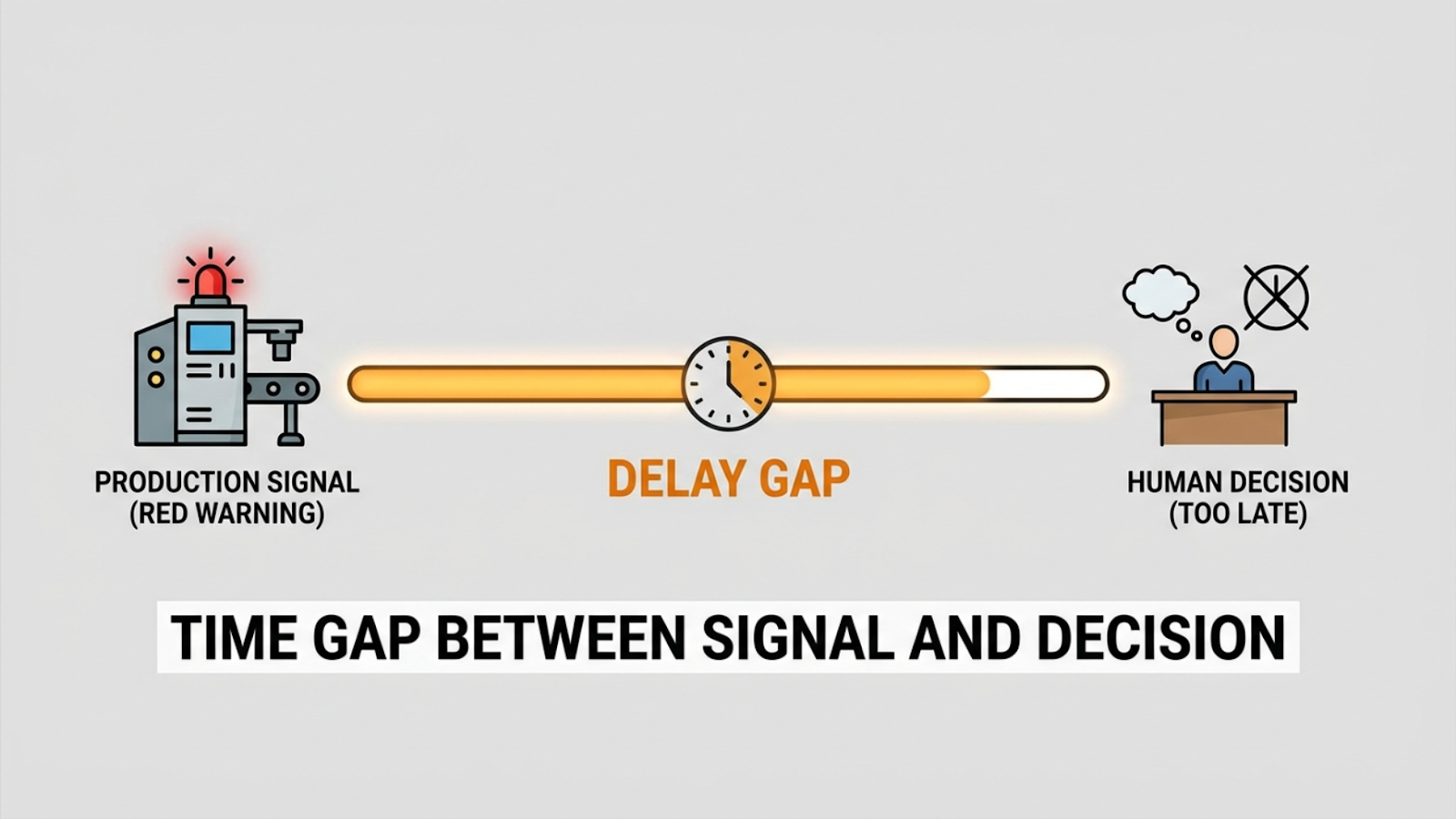
Decision latency is not theoretical—it is visible in everyday operations.
Production issues are detected, but not escalated immediately.
Inventory data exists, but does not reflect actual conditions in real time.
Procurement decisions are delayed due to approval chains.
Critical decisions require alignment across multiple teams before action is taken.
Each delay appears manageable in isolation.
But collectively, they create systemic inefficiency.
These are not failures of systems.
They are failures in decision timing and execution flow.
Decision latency has a compounding effect on manufacturing performance.
A delay at one point in the process creates ripple effects across the entire operation.
Production becomes less predictable.
Inventory buffers increase to compensate for uncertainty.
Response time to disruptions slows down.
Over time, this leads to:
Organizations may appear operationally active, but they are not operating at their full potential.
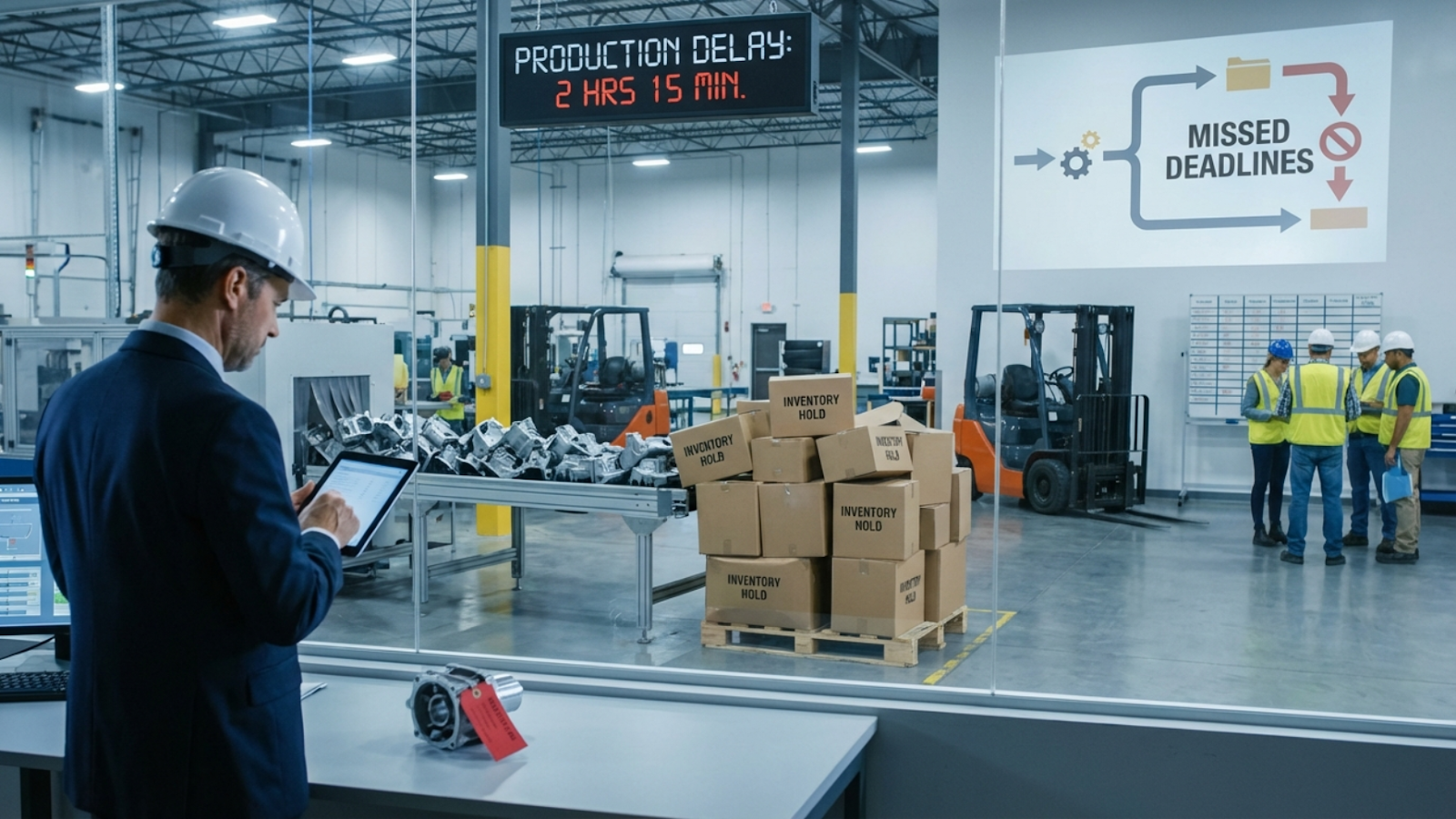
Manufacturing is no longer constrained only by machines, capacity, or systems.
The constraint has shifted.
It is now defined by how fast an organization can:
Reducing decision latency requires more than improving data visibility.
It requires redesigning how decisions flow across systems, teams, and processes.
The next frontier of manufacturing performance is not just automation or digitalization.
It is decision speed and execution quality.
Until decision latency is addressed, even the most advanced systems will continue to deliver suboptimal results.
Manufacturing is no longer limited by machines.
It is limited by how fast decisions are made.
If you want to identify where decision delays exist in your operations:
👉 Request the full report or reach out for a quick diagnostic.
decision latency in manufacturing
manufacturing performance improvement
shop floor decision making
manufacturing inefficiency
production delay causes
operational decision making manufacturing